


Token and Cashless: Two Models Compared for Event Management

The Traditional Solution: What Are Tokens?
The token system was created with the goal of simplifying payments and remains widely used partly because it requires a relatively low initial investment. Tokens are easy to produce and represent an immediate, accessible choice for many organizers.
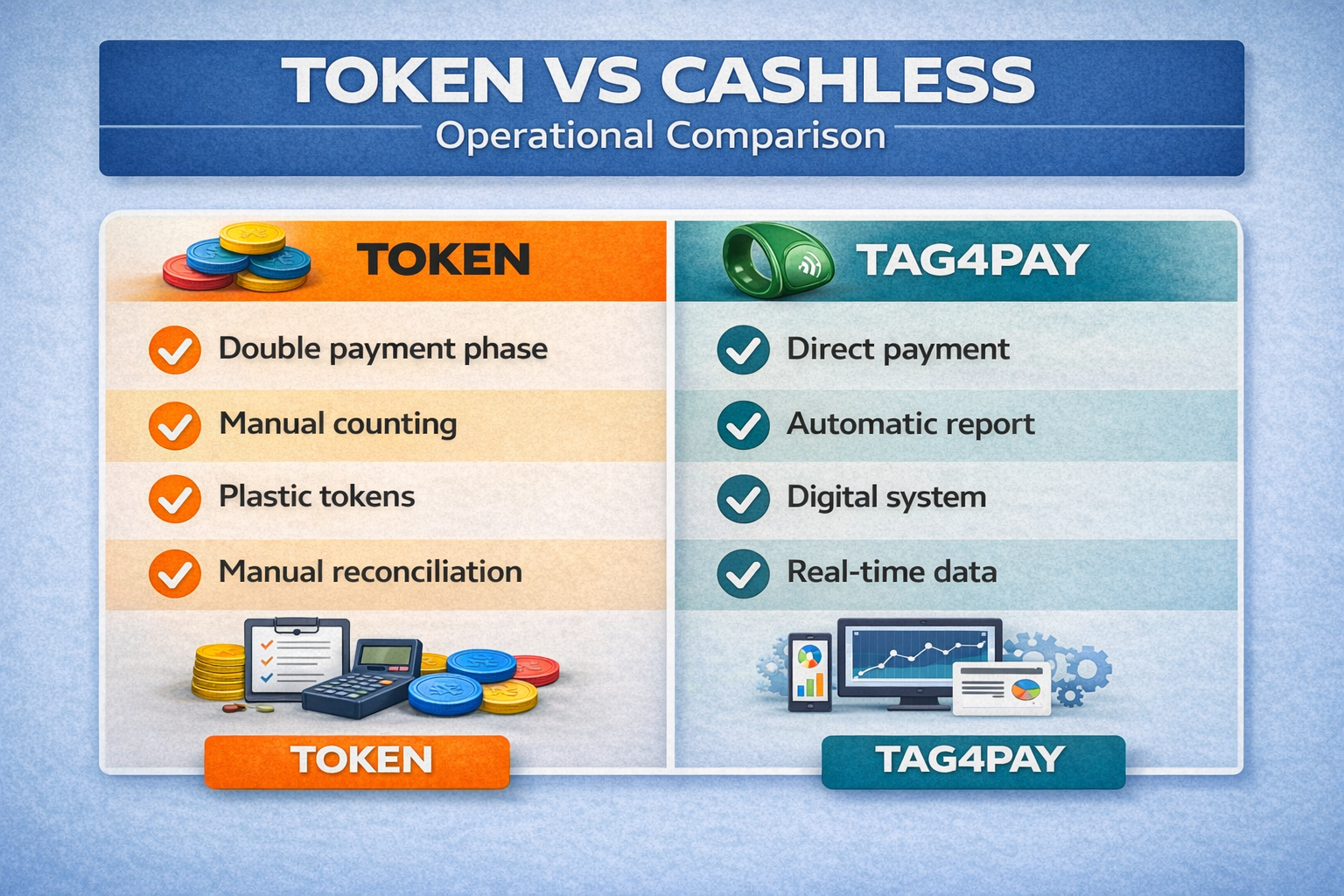
But how does this solution work? Attendees purchase tokens at a central cash desk and then use them to pay for food, beverages, or services within the event. This way, individual stands do not handle cash directly and revenue is centralized. On paper, it is a straightforward mechanism. In practice, however, it has revealed certain operational challenges. During peak attendance, the central cash desk inevitably becomes a bottleneck. Attendees must first queue to buy tokens and then queue again to make their purchases. This double step slows down the natural flow of the event and affects the overall attendee experience.
Another aspect that has become increasingly relevant in recent years is hygiene. As tokens pass from hand to hand throughout the event, they are handled by operators and participants hundreds of times. This constant exchange of physical objects is not the most suitable solution when considering today’s standards of health and safety awareness.
Another operational aspect becomes particularly evident at the end of the event. The administrative closing phase involves manual tasks that can be complex and time-consuming. Tokens must be:
-
physically counted
-
reconciled with the number distributed
-
checked against recorded revenues
-
reviewed for any discrepancies
This process requires time, accuracy, and dedicated staff, and it can slow down the final financial reconciliation.
Finally, there is a sustainability consideration. Tokens are generally made of plastic and are produced in large quantities for each event. Even when reusable, they still carry an environmental impact related to manufacturing and logistics. Reducing or eliminating their use also means making a more environmentally responsible choice.

What Is Tag4Pay and How Does It Work
In this context, Tag4Pay was developed as a cashless payment system based on NFC/RFID technology, specifically designed for events. Each participant receives a personalized wristband — branded with the event’s logo and uniquely configured — which becomes their payment tool for the entire duration of the event.
The process is simple: to complete a transaction, attendees only need to tap the wristband on the reader. Within seconds, the payment is authorized and recorded, without the exchange of cash or physical objects.
The system can be set up in prepaid mode, allowing attendees to load credit before or during the event, or in postpaid mode, where purchases are recorded and settled in a single payment at the end. This flexibility enables organizers to choose the configuration that best fits the type of event and its audience.
From a management perspective, Tag4Pay enables:
-
automatic recording of every transaction
-
real-time access to data
-
immediate end-of-event reporting
-
elimination of manual counting
All transactions are automatically stored, and the system provides a complete, structured overview of the event’s financial performance.

Why Tag4Pay Represents an Evolution Compared to Tokens
The difference compared to a token-based system does not lie in revolutionizing the event’s organization, but in making it smoother and more efficient. The operational structure remains the same; what changes is the way transactions are managed and recorded.
With tokens, each transaction involves a manual step: the token must be handed over, collected, stored, and later counted. With Tag4Pay, payment is completed contactlessly within seconds, without handling physical objects. The process becomes faster and more streamlined, while keeping the overall event setup unchanged.
Operational speed also has a direct impact on sales capacity. When payments are quick and seamless, attendees are more likely to make additional purchases. A stand that can serve more people in the same amount of time has a greater opportunity to generate higher revenues, improving the overall profitability of the event.
Another key advantage concerns control and reconciliation. In a traditional system, verification mainly takes place after the event, through physical counting and manual reconciliations. With Tag4Pay, every transaction is already recorded and available in the system. Organizers can monitor sales performance in real time and manage the administrative closing phase in a much simpler and more structured way.
Tangible Benefits for Attendees
Attendees benefit as well. The payment process becomes smoother and more intuitive, eliminating the need to carry cash or collect tokens while trying to estimate in advance how many will be needed.
The wristband remains with the participant at all times, reducing the exchange of physical objects and making the process more organized and hygienic. Fewer queues and shorter waiting times lead to greater satisfaction and a more professional perception of the event.
Real-World Applications
Looking Ahead in Event Management
If the token system once represented a game-changer in event organization, the same can now be said for Tag4Pay.
In a context where attendance, audience expectations, and sustainability awareness continue to grow, having a tool that ensures speed, traceability, and greater accuracy becomes a real competitive advantage. Looking ahead means adopting solutions that make complexity easier to manage—without making the organization itself more complicated.